Top Pick: portable wireless sonar with a dedicated colour screen
Budget handheld kits, GPS castables and larger boat displays
Compare scanning depth, connection range and power needs
A good fish finder helps answer the questions you cannot resolve by looking at the surface: how deep is the swim, where does the bottom change, and are there promising targets below? The most useful model is one that gives you those answers in a format you will actually use.
Our Top Pick is the Portable Smart Wireless Fish Finder. Its dedicated colour display and wireless sonar make it an appealing choice for straightforward bank and platform fishing, with no need to use your phone as the screen. The Portable Wired Sonar Fish Finder is our budget choice, while the Garmin STRIKER Vivid 7cv is the premium option for a larger, more permanent boat setup.
The ten picks below range from simple handheld kits to GPS-equipped castable sonar. Compare the way each one works as well as its range: a portable depth checker and a seven-inch boat display earn their place for very different reasons.
Want a better picture of your swim without turning your phone into another piece of fishing tackle? The Portable Smart Wireless Fish Finder is our top pick for that straightforward approach. Its dedicated colour display puts depth, the bottom profile and sonar targets in one place, with physical buttons beside the screen for navigating the readout.
The wireless sensor is the main convenience. You can assess the water from the bank or a platform without running a transducer cable back to the display. The 125kHz sonar uses a 45° cone, while the compact receiver is easy to work into a portable setup. It is an appealing step up from the simplest fish-icon screens if you want more visual context.
Choose it for everyday depth checks and exploring a swim. Its specified detection range is 0.6–36m, and GPS mapping is not listed. Anglers wanting saved lake maps or a permanently installed boat system should look at the more specialist options below.
36m depth limit is separate from the 100m wireless range
Wide beam is less suited to pinpointing a narrow feature
This wireless LCD kit is a useful middle ground between a basic cabled finder and a more expensive mapping system. A separate receiver displays the sonar information, while the floating sensor removes the cable that would otherwise connect the two.
Its appeal is flexible positioning at a modest price. The specified wireless operating range is up to 100m, while the 90° sonar cone provides broad coverage beneath the sensor. That can be helpful when you want to check general depth and target activity before deciding where to fish.
Do not confuse transmission distance with scanning depth: this model reads water from around 0.6m to 36m deep. Actual wireless range depends on conditions and a clear signal path. It is a sensible option for simple sonar feedback, while the Garmin and GPS-equipped Deeper choices offer more developed mapping tools.
Wired transducer limits deployment compared with wireless kits
Basic display; splash resistance does not mean submersible
For occasional use, this compact wired finder covers the essentials without a large outlay. The simple two-inch display shows depth and fish indications, with sensitivity adjustment and an audible alert to help you monitor changes without constantly studying the screen.
A cabled transducer makes sense when you are checking the water close to a boat, kayak or fishing platform. There is no wireless pairing to manage, and four AAA batteries make it easy to carry a spare set. The white backlight is useful as the light fades; batteries are not included.
Keep expectations proportionate to the price. The display is much simpler than a colour sonar graph, and the handheld unit should be protected from immersion. The specification distinguishes a maximum 100m depth readout from a 0.6–73m target-detection range, so the headline depth figure is not a guarantee of finding fish at 100m.
Key details
200kHz wired sonar; 45° cone
Two-inch backlit LCD
Four AAA batteries required, not included
Maximum depth readout 100m; specified target range 0.6–73m
The XF03 is worth considering if you like the simplicity of a wired kit but want more visual information than a basic fish-icon display. Its colour readout shows the bottom profile alongside depth and target indications, giving you more to interpret as you move the sensor.
Five sensitivity levels let you adjust the response to the water conditions, while selectable metres or feet and a backlight cover the everyday essentials. The narrow handheld body and controls beneath the screen suit one-handed use, and the transducer can be immersed or mounted appropriately beside a kayak or small boat.
It remains a straightforward depth-and-target finder: there is no GPS mapping or wireless sensor. The specified detecting range is 0.6–73m, so choose it for practical portable scanning rather than the larger depth figures sometimes attached to this style of kit. Plan where the cable will sit so it stays clear of your line and paddle.
Traditional CHIRP and ClearVü with the included GT20-TM
GPS waypoints and Quickdraw contour mapping
Cons
Needs mounting, wiring and an external power supply
No SideVü scanning on the 7cv
The STRIKER Vivid 7cv is the upgrade to consider when a fish finder will be a regular part of your boat setup. Its seven-inch screen makes more room for interpreting the water below you, rather than compressing everything into a small handheld display.
This package includes the GT20-TM transducer for traditional CHIRP sonar and ClearVü views beneath the boat. GPS lets you save useful positions, while Quickdraw Contours builds a picture of the depths you travel over. The different colour palettes give you options for making returns stand out.
Budget for the installation as well as the display: it needs a suitable external power supply, a secure mount and careful transducer placement. The 7cv provides downward scanning, not the SideVü capability of the 7sv. It is best suited to anglers who will use the larger screen and mapping repeatedly.
Key details
Seven-inch colour display
GT20-TM transducer included in this package
Traditional CHIRP and ClearVü sonar
Built-in GPS; Quickdraw Contours
Key features
Easy-to-use 7” color fishfinder with new vivid scanning sonar color palettes to easily distinguish fish and structure; tilt/swivel bailmount bracket included
Includes a GT20 transducer for built-in Garmin CHIRP traditional sonar and CHIRP ClearVü scanning sonar
High-sensitivity GPS to mark waypoints, create routes and view your boat’s speed
Includes built-in Quickdraw Contours mapping
Wi-Fi connectivity allows you to connect to the ActiveCaptain app with compatible smartphone to transfer waypoints, receive smart notifications (including...
GPS waypoints help you return to productive positions
Quickdraw builds your own depth contours
Dedicated display with dual-beam transducer
Cons
Smaller screen than the Vivid 7cv
Needs external power and transducer mounting
The STRIKER Plus 4 is a practical choice when you want useful boat-fishing tools without dedicating a large area to a screen. It combines a compact display with traditional CHIRP sonar, GPS positioning and Quickdraw contour recording.
That combination matters more than a long list of display effects. You can mark a useful position, see how the depth changes as you move and start building your own understanding of a water. The linked package includes a dual-beam transom transducer, making it a more complete starting point than a display-only listing.
There is still installation to plan. A kayak needs a suitable power arrangement and somewhere to hold the transducer securely; this is not a castable bank-fishing gadget. It also lacks ClearVü on this particular model. Choose it for compact GPS sonar rather than assuming it has every feature of the larger STRIKER units.
Key details
Traditional CHIRP sonar
Dual-beam transom transducer package
Built-in GPS and waypoint marking
Quickdraw contour recording
Key features
Includes dual-beam transducer with Garmin CHIRP traditional Sonar for crystal-clear images and remarkable target separation
Built-in Garmin Quickdraw contours Mapping software lets you create and store maps with 1-foot contours for up to 2 million acres
Built-in GPS lets you mark waypoints, create routes and view boat’s speed
Bright, sunlight-readable 4.3” display and intuitive user interface
Rugged design for every fishing environment, IPX7 water rating
Uses your compatible phone or tablet as the screen
GPS use reduces the maximum battery runtime
The Deeper CHIRP+ 2 suits anglers who want to spend time reading a swim in detail. Instead of carrying a separate receiver, you connect it to a compatible phone or tablet and work with the sonar through the Fish Deeper app.
Three CHIRP beams let you change the balance between broad coverage and a narrower look at a feature. Built-in GPS adds another useful dimension: you can create depth maps while casting from the bank, rather than simply watching each cast in isolation. It also has a specified shallow-water minimum of 15cm, with a maximum scanning depth of 100m.
The extra capability brings a little more preparation. Charge both devices, check the app on your phone and match your casting tackle to the sonar. Battery life is specified at up to nine hours with GPS on or fifteen with it off. Choose it when detailed scans and mapping justify the premium over a simpler finder.
Key details
Three-frequency CHIRP sonar
Built-in GPS; Fish Deeper app
Specified scanning depth: 15cm–100m
Up to 9 hours with GPS on; 15 hours with GPS off
Key features
SMART FISHING GADGET - Powerful castable and most advanced CHIRP fish finder GPS sonar by Deeper with three beam frequencies, crisp clarity and extreme...
HIGH SPEC FISHING GEAR - Castable fish finder that casts out to 120 m with solid connectivity. Accurate scanning in water from 15 cm to 100 m deep. Precise 1 cm...
FAST CHARGING POWERFUL BATTERY - This under water fish finder will last up to 15 hours. Charge the battery of this smart fish finder to 100% in just 2 hours...
DEPTH FINDER MAPS - Map out the waters with Deeper CHIRP+ 2 under water fish finder to create depth maps from shore, boat, canoe, or kayak. Access all your...
FISH DEEPER APP AND WEB PLATFORM - Plan your fishing trips and map the waters you fish to maximize your catch rate: know when and where to fish, measure the...
Wi-Fi connection does not need mobile reception for sonar
Cons
Requires a compatible phone or tablet
Uses fixed sonar frequencies rather than CHIRP
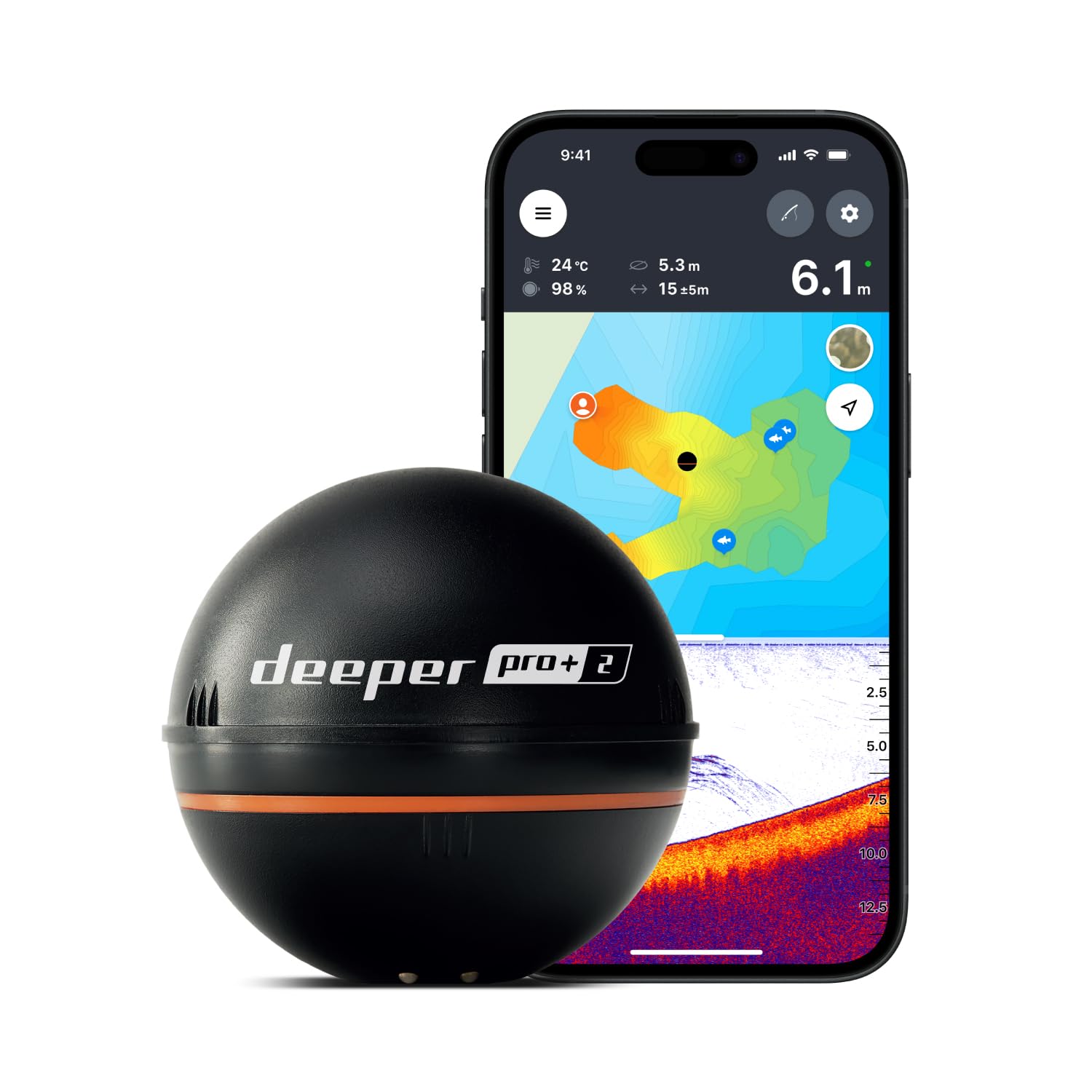
The PRO+ 2 is a strong alternative if the main reason for buying a castable finder is to learn the shape of a lake. Its built-in GPS allows you to create depth maps from the bank, with readings shown and saved through the Fish Deeper app.
There are three beam choices: a broad scan for an overview, a medium option and a narrow beam for closer inspection. The unit creates its own Wi-Fi connection, so sonar readings do not depend on having mobile reception at your fishing spot. Specified connection and maximum scanning depth are both up to 100m, although they describe different things.
Compared with the CHIRP+ 2, the PRO+ 2 uses fixed sonar frequencies. For someone focused on mapping and exploring features rather than choosing the more advanced CHIRP model, that can be a worthwhile saving. Keep phone battery life, casting weight and weather protection in mind when planning a full session.
Key details
Three sonar beams: 7°, 20° and 47°
Built-in GPS
Up to 100m Wi-Fi connection and 100m scan depth
Specified runtime: up to nine hours
Key features
READY TO PERFORM - Locate where your next catch is hiding faster with the Deeper PRO+ 2 Fish Finder! The wide beam, mid and narrow beams make covering large...
SMART TECHNOLOGY - Use cutting edge technology to your advantage with our fish finders & depth finders with accuracy at up to 100 m/330 ft. By generating its...
PINPOINT ACCURACY - This phone fish finder displays unerring accuracy in the water. With a target separation of 1 cm/0.4 in (narrow beam) and 2.4 cm/1 in (wide...
BUILT-IN GPS - Our portable sonar fish finder allows you to create bathymetric maps from the shore, dock, or bank simply and effectively, all you have to do is...
GAME CHANGING CAPABILITIES - Deeper's fishing gear and equipment keeps you on top of your game wherever you fish! From boat, kayak, shore, bank and even ice...
The START is the Deeper to consider if you mainly want an easier way to check depth and look for fish indications from the bank. Its appeal is simplicity: pair the sonar with a compatible phone, deploy it and view the readings in the Fish Deeper app.
The single 40° beam gives a useful overview without asking you to choose between several frequencies. Its specified wireless range reaches 50m, with scanning from 0.5m to 50m deep. The app offers fish icons as well as a raw sonar view, making it possible to start simply and learn more about what the returns mean.
This model does not include the built-in GPS mapping hardware of the PRO+ 2. It is therefore best for checking individual swims rather than creating detailed shore-cast depth maps. Allow for the phone’s power use alongside the sonar’s stated battery life of up to six hours.
Key details
Wi-Fi connection to a compatible phone or tablet
Single 120kHz, 40° sonar beam
Specified depth: 0.5–50m; range up to 50m
Battery life: up to six hours
Key features
READY TO GO - Easily find where your next catch is hiding with the Deeper START Fish Finder! The lightweight and sleek design makes for a seamless reel without...
SMART TECHNOLOGY - Use innovative, cutting-edge technology to your advantage with our fish finders & depth finders. By generating its own Wi-Fi, our START depth...
SIMPLE AND EFFECTIVE - This phone fish finder has you fishing in minutes! Simply pair with the Fish Deeper app on your mobile device and instantly see useful...
IMPRESSIVE SPECS - Our portable sonar fish finder boasts high-level specs that help you make the most of each trip! Casting far out to 165 ft / 50 m and also...
STAY OUT FOR LONGER - Deeper's fishing gear and equipment keeps you on top of your game for longer! Reaching full charge in just 2.5 hours, this fish sonar...
About 30m Bluetooth range is shorter than the Wi-Fi options
Check current app compatibility before buying
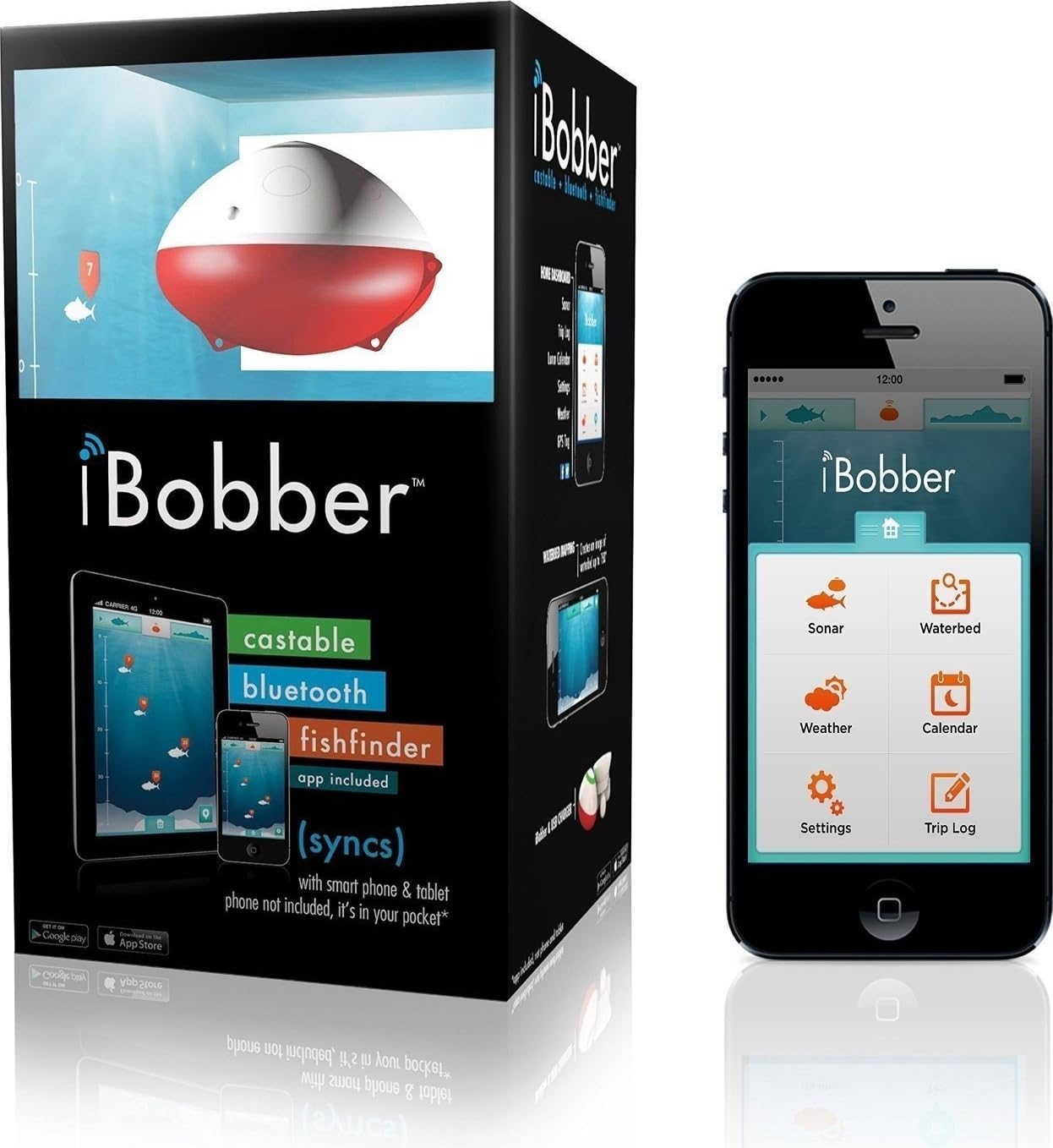
The iBobber is an easy-to-pack option for anglers who want a compact sonar for closer-range work. It floats on the water and sends readings to its companion phone app over Bluetooth, leaving you without a separate handheld receiver to carry.
The app can show fish icons or raw sonar, while the illuminated beacon is useful for keeping track of the unit as the light falls. You can also log sessions and save favourite spots using the phone-based tools. Its specified scanning depth reaches 135ft, or roughly 41m.
The main trade-off is connection range: the stated 100ft is approximately 30m, considerably less than the longer-range Wi-Fi models here. Check that the current app supports your phone before ordering. It is a compact choice for short casts and portable use, rather than the first pick for surveying distant areas of a large lake.
Key details
Bluetooth connection: up to 100ft / around 30m
Specified maximum depth: 135ft / around 41m
Rechargeable battery; LED beacon
Compatible smartphone and iBobber app required
Key features
Sonar depth up to 135 feet depth scale, fish depth
Tags two fish sizes under and over 38 cm. IBobber syncs with iOS 6.0, 7.0 and 8.1 operating systems (Apple). Phone and tablets for Android (v4.3), using...
Built-in strike alarm, alerting you when the fish bite
Bluetooth Smart v4.0 maintains a strong, low energy connection with a smart device
Start with where you fish. A handheld kit, a phone-connected castable sonar and a powered boat display solve different problems. The right one should make your normal fishing routine easier, rather than add equipment you rarely use.
Which type of fish finder should I buy?
For bank or platform fishing, a portable wireless kit gives you a dedicated screen without a trailing sonar cable. A castable phone-connected model saves carrying that separate receiver and can add mapping on GPS-equipped versions. For repeated use from a boat or kayak, a mounted display offers a screen that stays in place, but needs power and a properly positioned transducer.
Is wireless range the same as scanning depth?
No. Wireless range is the distance between the floating sensor and its receiver or phone. Scanning depth is how far the sonar can read below the water. A model described as having 100m wireless range may only scan to 36m. Compare both figures, and treat maximum ranges as best-condition specifications rather than guaranteed performance in every swim.
Do I need GPS?
GPS is useful for marking positions and, on suitable models, building depth maps. Deeper PRO+ 2 and CHIRP+ 2 have onboard GPS for mapping from shore; the Garmin models can mark positions and record Quickdraw contours as you move. A basic depth finder can still be useful without GPS. Saving a point through a phone app is not the same as having a GPS receiver inside the floating sonar.
What do narrow and wide sonar beams change?
A wide cone covers more water beneath the sensor and can help you get an overview. A narrow cone concentrates on a smaller area, which is useful when examining a feature or separating nearby returns. A fish shown on a wide-beam screen can be anywhere within that cone; the picture is not a camera view or an exact horizontal position.
What is CHIRP, and is it worth paying for?
CHIRP sonar sweeps through a range of frequencies rather than using only a single fixed frequency. It can help distinguish returns and show more detail. It is worth considering when interpreting structure and closely spaced targets matters to you. For occasional depth checks, a straightforward conventional sonar may provide enough information at a lower cost.
Can these show the species of fish?
Treat fish icons as an interpretation of sonar returns, not a confirmed species identification. Vegetation, clutter and other objects can affect what you see. Learn the bottom trace and compare repeated passes before deciding where to fish. Sonar can help you understand the water, but it cannot promise a bite.
What else should I budget for?
A handheld unit may need spare batteries; phone-based sonar needs a compatible charged device and suitable casting tackle. Boat systems need an appropriate battery or power connection, secure mounts and cable routing. Check the exact package for a transducer, because a display-only offer can look much cheaper than a complete kit.
Will a castable finder work without mobile signal?
The Deeper models create a local Wi-Fi link to the phone, while iBobber uses Bluetooth. Live sonar does not need mobile data, although downloads, cloud features and some map services can require internet access. Install and check the app before leaving home, and keep the receiver or phone positioned for a clear signal path.
How can I get more useful readings?
Follow the mounting instructions, keep the sensor properly in the water and start with a steady position or slow movement. Adjust sensitivity rather than assuming every mark is a fish. Waves, turbulence, water conditions and nearby obstructions can affect the picture. For casting, use tackle rated for the sonar’s weight and check that the fishery permits its use.